
Case study
Projectsroyeradames.comA portfolio I could return to
A portfolio I could return to
The short story
I built my portfolio to help people find my work. As it grew, I wanted it to help me remember the work too: what I tried, what changed, and how I got here. Project search made the work easier to find; the Education journey showed me how much more a record could mean when it told the story behind the facts.
- My role: I set the product direction and reviewed the content and design; AI coding agents wrote the code.
- What changed: a searchable project collection gained project records, case studies and an Education story with a shorter route for readers in a hurry.
- What I can show: the shipped site, earlier designs and the decisions recorded while building it. I have not yet measured whether this improves hiring outcomes.
Build: Royer Adames, with AI agents.
I wanted a place for the work
The starting point was my own address on the web. My résumé and projects belonged there. The applications I built could keep their own homes, with the portfolio helping someone find and open them.
But a list of projects left another question. What should someone see first? I tried treating the page as a résumé, a gallery and a place for side projects. The design had to make the work worth looking at while still making it easy to find.
One decision helped settle that tension. A project image could fill the first screen, but search and the way into the project had to remain available. If the presentation got in the way of finding something, finding it came first.
A card could only tell part of it
The project card was a preview. It could show a picture, explain what the project was and offer a way in. It could not also hold every version, decision and lesson without becoming something else.
In August, I separated those responsibilities. The card came first, then the project page as the fuller record, then a place to find the case studies. I wanted each step to lead somewhere real. A link to a project page had to wait until that page existed.
By August 30, the Case studies page was live. Each result named a study and its project. That gave the records a way to be found without requiring someone to discover them one project at a time.
The facts were there. The story was missing.
Education made the difference clear to me. A list of schools could name the places I had studied, but it did not explain the changes of direction between them.
I had started with an interest in computers, tried a course of study that was not what I had expected, changed direction at UCF and stepped away from college. Construction and AC work gave me a discipline I later brought back to software. Lambda School was part of that return. Getting hired was another beginning, because learning continued at work.
I worked through that story in words before settling the design. The photographs mattered too. The picture of my Lambda setup brought back the room, the screen and the time I spent studying. It did not need to look like a polished promotional photograph to belong in the story.
Seeing those pieces together moved me. This was no longer only information about where I had been. It was something I recognized as my own experience.
Different readers needed different ways through
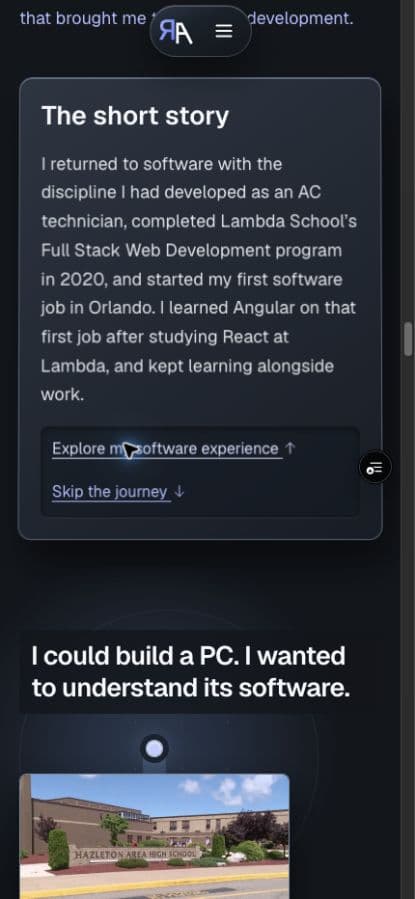
I still wanted a hiring reviewer to get the point quickly. The short story gave them a beginning, a change and an outcome, with a way to skip the longer journey.
The rest could take its time. Someone getting to know me could follow the changes of direction. I could return to the details I was starting to forget.
The layout followed that idea. A winding path carried the turns in the story, becoming narrower as my interests became more focused. The design, images and movement had a job: help someone follow what happened.
The Education journey and shared design system reached production on September 14. That was a completed part of the work, not the end of the portfolio. Reading the case studies again, I could see the next gap. Their summaries named what I tried, the result and the lesson, but many still stopped before telling the story.
What I learned
I do not have to choose between a quick explanation and a record worth spending time with. They serve different moments. A short story can help someone decide whether to continue; the fuller account can preserve the choices, difficulties and discoveries that made the work matter.
The journals give me somewhere to start when memory is incomplete. I can go back to what was recorded, check what changed and write from that evidence. Where the record is missing, I need to leave the gap visible instead of filling it with a better-sounding story.